Where this came from
This process did not exist under this name before the Eighth Edition. Here is what it was called, and where the previous write-up still lives:
Plan Sourcing Strategy is the process that decides how the project will get what it needs: what the team will do itself, what it will buy, and how the outside suppliers will be chosen. The result is the sourcing strategy plan.
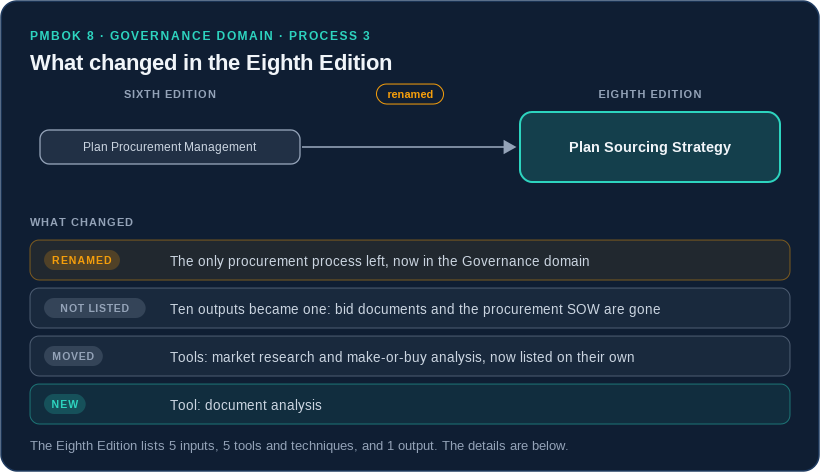
What changed
This is Plan Procurement Management under a new name, and the change is bigger than the name. In the Sixth Edition, procurement was a knowledge area of its own with three processes. In the Eighth Edition, only this one is left, and it sits in the Governance domain, in the planning focus area, next to Integrate and Align Project Plans.
The other two have no successor in the process set. Conduct Procurements and Control Procurements moved to an appendix on procurement, so awarding and managing contracts is no longer described as a project management process. The crosswalk maps all three.
“Sourcing” is a wider word than “procurement”. Procurement means buying. A sourcing strategy also covers the decision not to buy, and the process now starts from that question.
Ten outputs became one
The Sixth Edition listed ten outputs for this process. The Eighth Edition lists one: the sourcing strategy plan. Two of the old outputs now sit inside it: the source selection criteria, and the make-or-buy decisions, now called insourcing or outsourcing decisions.
Four of the old outputs appear nowhere in the Eighth Edition, in any process, at either level: bid documents, the procurement statement of work, independent cost estimates and the procurement strategy. They are the documents used to run a tender, and they left with the processes that ran one. The ITTO analysis counts every item that disappeared from the edition, and most of them are procurement.
The procurement management plan is still part of the project management plan: Acquire Resources lists it as an input and Plan Risk Responses can update it. But no process lists it as its output any more, this one included.
The tools are named for the decisions
There are still five tools, but only expert judgment and source selection analysis carried over as they were. Two others were already part of this process, listed inside broader categories:
- Market research, which the Sixth Edition listed under data gathering: what suppliers exist and what they can deliver.
- Make-or-buy analysis, which it listed under data analysis: whether the team does the work or pays someone else to.
The fifth tool, document analysis, is new to this process. Meetings are no longer listed.
The inputs barely moved
The inputs went from six entries to five: the project charter, the project management plan, project documents, enterprise environmental factors and organizational process assets. Business documents are no longer listed. Inside the plan, the cost management plan is now the financial management plan, as everywhere else in the edition.
If you learned the previous set
The thinking you studied still holds. Make-or-buy analysis, market research and source selection criteria are all still here, and the decision to buy still comes before anything is bought. Two things need updating. Learn the new names: sourcing strategy plan, and insourcing or outsourcing decisions. Estimate Costs still lists make-or-buy decisions as an input, so the two names describe the same decision. And expect less of the tender itself. Bid documents, the procurement statement of work and the steps of awarding a contract are no longer part of any process.
Contracts did not disappear, though. Agreements are an input to ten of the forty processes, from Initiate Project or Phase to Develop Budget and Identify Risks. The project still has to work within its contracts. The guide just no longer describes how they are awarded as a project management process.
Inputs, Tools & Techniques, and Outputs
Compared with the Sixth Edition’s Plan Procurement Management. Items marked New, Renamed or Moved changed; everything else carries over.
Inputs 5
- Project charter
- Project management plan
- Project documents
- Enterprise environmental factors
- Organizational process assets
No longer listed here: Business documents
Tools & Techniques 5
- Expert judgment
- Market research MovedWas listed under data gathering
- Make-or-buy analysis MovedWas listed under data analysis
- Source selection analysis
- Document analysis New
No longer listed here: Meetings
Outputs 1
- Sourcing strategy plan NewHolds the insourcing or outsourcing decisions, formerly make-or-buy decisions
No longer listed here: Procurement management plan; Procurement strategy; Bid documents; Procurement statement of work; Independent cost estimates; Change requests; Project documents updates; Organizational process assets updates
Now under sourcing strategy plan: Source selection criteria
Every ITTO column in the eighth edition ends in “Etc.”, so the guide presents these lists as typical, not complete. Grouped items such as project documents are shown at the top level. PMBOK® Guide — Eighth Edition, §2.1.6.3. What changed in the ITTOs, across all 40 processes.