Where this came from
This process did not exist under this name before the Eighth Edition. Here is what it was called, and where the previous write-up still lives:
Integrate and Align Project Plans is the process that assembles the project management plan. It takes the plans, baselines and decisions that other processes produce and makes them work as one plan, so that scope, schedule, finances, risk and the rest all describe the same project.
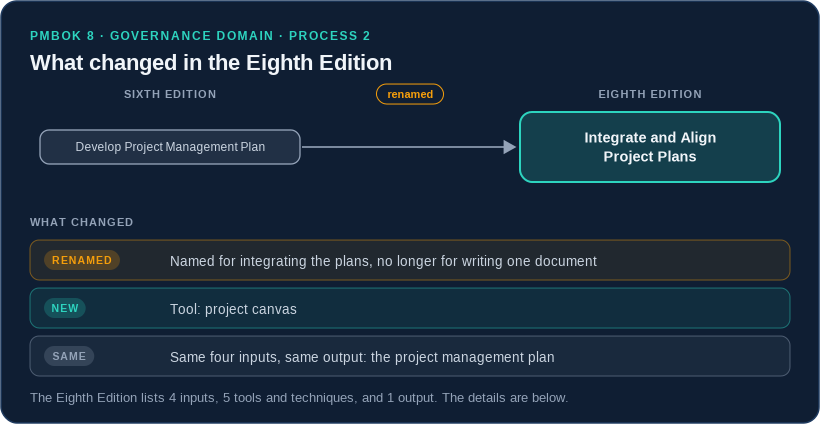
What changed
This is Develop Project Management Plan under a new name, and the name changed the same way as Develop Scope Structure: it now describes the work instead of naming a document. “Develop” suggested writing one plan from start to finish. “Integrate and align” describes the real job on any project of size. The component plans are written in many places, often by different people, and someone has to make them fit together and keep them consistent.
Very little else moved. The inputs are the same four as before: the project charter, outputs from other processes, enterprise environmental factors and organizational process assets. The output is still a single item, the project management plan. The process belongs to the Governance domain and its planning focus area.
One new tool: the project canvas
The tools list grew from four entries to five. Expert judgment, data gathering, interpersonal and team skills, and meetings are all still listed. The addition is the project canvas: a single page that sets out the essentials of the project.
The canvas appears in exactly two processes in the Eighth Edition: here and in Initiate Project or Phase. The pairing makes sense. On a small or adaptive project, the canvas drafted when the project is authorized can grow into the plan, instead of the plan being a separate document written afterwards. Listing it here says that a plan does not have to be long to count as a project management plan.
The input almost every process uses
The project management plan is the most widely used input in the edition: 37 of the 40 processes list it. The exceptions include this process, which produces it, and Initiate Project or Phase, which runs before there is a plan.
Most of the plan’s content arrives after this process first runs. Six of the nine processes whose names start with “Plan” list their own plan as project management plan updates: Plan Scope Management, Plan Schedule Management, Plan Stakeholder Engagement, Plan Communications Management, Plan Resource Management and Plan Risk Management. The plan grows by adding components to one plan, and this process is where those components are brought into line with each other.
What the plan contains now
Most of the components are familiar: the scope, schedule and cost baselines, management plans for scope, requirements, schedule, quality, resources, communications, risk, procurement and stakeholder engagement, and the change and configuration management plans. Three differences are worth knowing:
- The cost management plan is now the financial management plan, produced by Plan Financial Management.
- There is no Plan Quality Management process any more. The quality management plan survives, Plan Scope Management lists it among its plan updates, and Manage Quality Assurance carries it out.
- There is no Plan Procurement Management either. Its successor, Plan Sourcing Strategy, produces a sourcing strategy plan, while the procurement management plan is still named as a component of the plan.
If you learned the previous set
The substance is what you studied. The plan integrates the subsidiary plans and the baselines, it is elaborated progressively, and once it is baselined it changes only through Assess and Implement Changes. Two things need updating: the name, and the idea that on a small or adaptive project a one-page canvas can be the core of the plan. In a scenario where two component plans contradict each other, resolving the conflict is the work of this process.
Inputs, Tools & Techniques, and Outputs
Compared with the Sixth Edition’s Develop Project Management Plan. Items marked New, Renamed or Moved changed; everything else carries over.
Inputs 4
- Project charter
- Outputs from other processes
- Enterprise environmental factors
- Organizational process assets
Tools & Techniques 5
- Expert judgment
- Data gathering
- Interpersonal and team skills
- Meetings
- Project canvas New
Outputs 1
- Project management plan
Every ITTO column in the eighth edition ends in “Etc.”, so the guide presents these lists as typical, not complete. Grouped items such as project documents are shown at the top level. PMBOK® Guide — Eighth Edition, §2.1.6.2. What changed in the ITTOs, across all 40 processes.