Where this came from
This process did not exist under this name before the Eighth Edition. Here is what it was called, and where the previous write-up still lives:
Manage Quality Assurance is the process that checks how the project works, not what it produces. It makes sure the team follows the processes, standards and rules that were agreed, so that stakeholders can trust the result will meet their needs. It runs for the whole project.
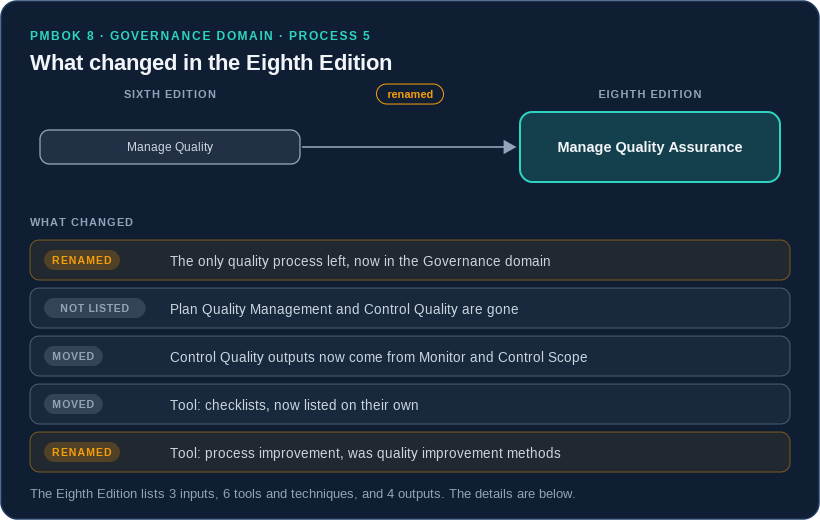
What changed
This is Manage Quality under a new name. The Sixth Edition already described that process as quality assurance. The Eighth Edition puts the word in the name.
The bigger change is around it. In the Sixth Edition, quality was a knowledge area with three processes. In the Eighth Edition there is no quality domain, and this is the only process left with “quality” in its name. It sits in the Governance domain, in the executing focus area, next to Manage Project Execution and Manage Project Knowledge.
The guide explains the split directly. Quality assurance is about using the project’s processes well: following standards, meeting regulations, passing audits. Quality control is about making deliverables that meet their specifications: design, testing, defects. This process covers the first. The second no longer has a process named after it.
Where the other two quality processes went
Plan Quality Management has no successor. The quality management plan still exists, and this process still carries out what it defines. But no process produces it as its main output anymore. Plan Scope Management lists it as an update to the project management plan, and it also took over test and inspection planning as a tool. Quality metrics are still an input to other processes, but no process lists them as an output.
Control Quality is split across the Scope domain. Its two typical outputs, verified deliverables and quality control measurements, are now outputs of Monitor and Control Scope, along with testing and product evaluations as a tool. Validate Scope then takes the verified deliverables as an input and has two objectives: checking the processes used to meet the quality standards, and formal acceptance.
| Sixth Edition | Eighth Edition | What to remember |
|---|---|---|
| Plan Quality Management | No process of its own | The quality management plan is an update from Plan Scope Management |
| Manage Quality | Manage Quality Assurance (Governance) | Same job, now named for it: are we using the right processes? |
| Control Quality | Monitor and Control Scope, then Validate Scope | Deliverables are verified first, then accepted |
The tools: one moved, one renamed, two not listed
The Sixth Edition listed eight tools for this process. The Eighth Edition lists six. Four carried over as they were: audits, data representation, decision-making and problem-solving. Two changed:
- Checklists are now listed on their own. The Sixth Edition listed them under data gathering.
- Process improvement replaces quality improvement methods. The new name matches the purpose of the process: improve the way the work is done, not inspect what it produced.
Data analysis and design for X are no longer listed. Every list in the Eighth Edition ends with “etc.”, so this does not forbid them. Root cause analysis, for example, is still listed under data analysis in Monitor and Control Scope and in Monitor and Control Project Performance.
Inputs and outputs
The inputs did not change: the project management plan, project documents and organizational process assets. The guide now names the assets that matter most here: the organization’s policies, procedures and regulations.
The outputs went from five to four. Quality reports, change requests and the two kinds of updates carried over. Test and evaluation documents are no longer an output here. Under the name quality test and evaluation documents they appear only as an input to Monitor and Control Scope.
Quality reports are the output to follow. They go to Monitor and Control Project Performance, Validate Scope, Manage Communications and Close Project or Phase, so the findings of assurance reach the people who decide and the customer who accepts.
If you learned the previous set
The difference you studied still holds, and the guide now states it more strongly: assurance looks at the process, control looks at the product. Assurance aims to prevent problems, and control finds them in the work. Three things need updating. There is no quality planning process, so the quality management plan comes from planning in general, mainly Plan Scope Management. Quality control work now sits in the Scope domain. And assurance itself is tailored: on predictive projects it is usually formal, on adaptive projects it can be formal or informal, and it can be done by the project team, by an outside party, or by both.
Inputs, Tools & Techniques, and Outputs
Compared with the Sixth Edition’s Manage Quality. Items marked New, Renamed or Moved changed; everything else carries over.
Inputs 3
- Project management plan
- Project documents
- Organizational process assets
Tools & Techniques 6
- Audits
- Checklists MovedWas listed under data gathering
- Data representation
- Decision-making
- Problem-solving
- Process improvement RenamedWas quality improvement methods
No longer listed here: Data analysis; Design for X
Outputs 4
- Quality reports
- Change requests
- Project management plan updates
- Project document updates
No longer listed here: Test and evaluation documents
Every ITTO column in the eighth edition ends in “Etc.”, so the guide presents these lists as typical, not complete. Grouped items such as project documents are shown at the top level. PMBOK® Guide — Eighth Edition, §2.1.6.5. What changed in the ITTOs, across all 40 processes.