Where this came from
This process did not exist under this name before the Eighth Edition. It merges what were previously separate processes:
Monitor and Control Scope is the process that watches the scope while the work runs. It tracks the project and product scope against the scope baseline, manages changes to that baseline, and checks that the deliverables meet their quality requirements. It runs for the whole project.
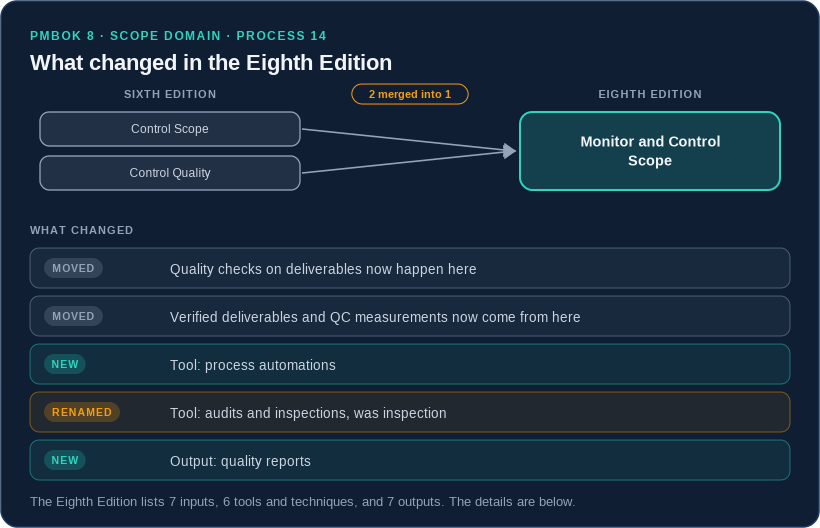
What changed
This process merges two Sixth Edition processes: Control Scope and Control Quality. The scope half is familiar: compare the work with the baseline, find the variances, raise change requests. The guide adds the quality half to it: measuring the deliverables against their quality requirements and recording the results. Checking how much was built and checking whether it was built right now happen in the same process.
The name follows the pattern of the other monitoring processes in this edition, such as Monitor and Control Schedule and Monitor and Control Finances. The process sits in the Scope domain, in the monitoring and controlling focus area.
Verified first, accepted second
The order of the two checks on a deliverable did not change, only the process where the first one happens. Monitor and Control Scope checks deliverables for correctness. Validate Scope then gets them formally accepted. In the Sixth Edition the same chain ran from Control Quality to Validate Scope.
| Step | Process | Takes in | Hands on |
|---|---|---|---|
| 1. Check correctness | Monitor and Control Scope | Deliverables | Verified deliverables, quality control measurements |
| 2. Formal acceptance | Validate Scope | Verified deliverables, quality control measurements | Accepted deliverables |
A deliverable that fails the first check does not move on. It is corrected, inspected again and re-verified, and only then goes to acceptance.
The tools: one list from two
Control Scope had a single tool in the Sixth Edition, data analysis. Control Quality had six. Monitor and Control Scope lists six. Data analysis comes first, with variance, trend and root cause analysis under it. Testing and product evaluations and data representations carried over from Control Quality. Three entries changed:
- Performance reviews are now listed on their own. In Control Quality they sat under data analysis. They compare the actual work with what was planned.
- Audits and inspections replace inspection. An audit checks independently that project activities follow the organization’s policies and procedures. An inspection examines a work product to see whether it conforms to its standards.
- Process automations are new. The guide means software, or a software robot, that does routine work which can be written down as rules. Its own examples are general: scheduling meetings and sending reminders. In this process, automated tests and checks are the obvious use.
Data gathering and meetings are no longer listed. Every list in the Eighth Edition ends with “etc.”, so this does not forbid them.
Inputs and outputs
The inputs are the ones Control Quality used: the project management plan, project documents, approved change requests, the deliverables themselves, enterprise environmental factors and organizational process assets. Quality metrics are now listed on their own; the Sixth Edition put them under project documents. No process in the Eighth Edition lists quality metrics as an output.
One input is missing. Work performance data is not listed here, although Validate Scope and six other monitoring processes list it. The process still measures performance; the guide simply names the deliverables and the measurements as what it works from.
The outputs combine both predecessors. From Control Scope: work performance information, change requests and the updates. From Control Quality: verified deliverables and quality control measurements. Quality reports are new here. In the Sixth Edition only Manage Quality produced them. Now Manage Quality Assurance and this process both list them as outputs, and Validate Scope updates them. The work performance information goes to Monitor and Control Project Performance, and change requests go to Assess and Implement Changes.
If you learned the previous set
Keep the difference between verified and accepted. Verified means the team checked the deliverable against the requirements. Accepted means the customer or sponsor signed it off. Verification still comes first. What changed is the name to give: in a scenario about inspecting deliverables, measuring defects or testing a product, the answer is now Monitor and Control Scope, not a quality process. Scope creep is handled as before: find the variance here, raise a change request, and let the change process decide.
Inputs, Tools & Techniques, and Outputs
Compared with the Sixth Edition’s Control Scope and Control Quality. Items marked New, Renamed or Moved changed; everything else carries over.
Inputs 7
- Project management plan
- Project documents
- Quality metrics MovedWas part of project documents
- Approved change requests
- Deliverables
- Enterprise environmental factors
- Organizational process assets
No longer listed here: Work performance data
Tools & Techniques 6
- Data analysis
- Performance reviews MovedWas listed under data analysis
- Audits and inspections RenamedWas inspection
- Testing/product evaluations
- Data representations
- Process automations New
No longer listed here: Data gathering; Meetings
Outputs 7
- Quality reports New
- Verified deliverables
- Change requests
- Quality control measurements
- Project management plan updates
- Project document updates
- Work performance information
Every ITTO column in the eighth edition ends in “Etc.”, so the guide presents these lists as typical, not complete. Grouped items such as project documents are shown at the top level. PMBOK® Guide — Eighth Edition, §2.2.2.5. What changed in the ITTOs, across all 40 processes.