Where this came from
This process did not exist under this name before the Eighth Edition. Here is what it was called, and where the previous write-up still lives:
Monitor and Control Schedule is the process that tracks the timeline while the work runs: measuring progress against the schedule baseline, forecasting when the work will really finish, and raising change requests when the dates slip.
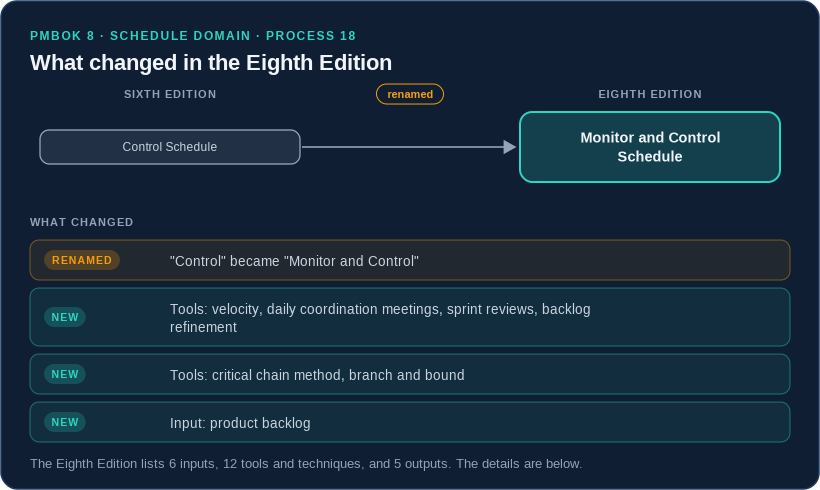
What changed
This is Control Schedule under a new name. “Monitor and” brings it in line with the other monitoring processes in the edition, such as Monitor and Control Project Performance and Monitor and Control Finances. The outputs are the same five as before: work performance information, schedule forecasts, change requests, and updates to the plan and the project documents.
The tools list doubled
The tools went from six entries to twelve. All six of the Sixth Edition’s tools are still there: data analysis, the critical path method, the project management information system, resource optimization, leads and lags, and schedule compression. Four of the six additions come from adaptive delivery:
- Velocity: how much work the team finishes per iteration, used to forecast when the backlog will be done.
- Daily coordination meetings and sprint reviews: the points where an adaptive team sees, day by day and iteration by iteration, whether it is on pace.
- Backlog refinement: re-ordering and re-sizing the remaining work, which is how an adaptive project changes its schedule.
The other two are scheduling techniques: the critical chain method, which joined Develop Schedule in this edition too, and branch and bound, an optimization method that searches the possible schedules for the best one while ruling out options that cannot beat it.
The product backlog is an input
The input list grew from four entries to six. The product backlog is new, and it matches the new tools: on an adaptive project, schedule progress is measured against the backlog, by how much of it is done and how fast the team is getting through it. Enterprise environmental factors are now listed as well.
If you learned the previous set
Earned value is still the main measure on a predictive project. Schedule variance and the schedule performance index tell you whether the work is ahead of or behind the plan, and you can practise both on your own numbers with the earned value calculator. What is new is that velocity and a burndown chart answer the same question on an adaptive project, and the guide lists both in this process. In a scenario about an adaptive team, the evidence to look at first is the team’s velocity, not the critical path.
Inputs, Tools & Techniques, and Outputs
Compared with the Sixth Edition’s Control Schedule. Items marked New, Renamed or Moved changed; everything else carries over.
Inputs 6
- Project management plan
- Product backlog New
- Project documents
- Work performance data
- Enterprise environmental factors New
- Organizational process assets
Tools & Techniques 12
- Data analysis
- Critical path method
- Critical chain method New
- Project management information system
- Resource optimization
- Leads and lags
- Schedule compression
- Branch and bound New
- Velocity New
- Daily coordination meetings New
- Sprint reviews New
- Backlog refinement New
Outputs 5
- Work performance information
- Schedule forecasts
- Change requests
- Project management plan updates
- Project document updates
Every ITTO column in the eighth edition ends in “Etc.”, so the guide presents these lists as typical, not complete. Grouped items such as project documents are shown at the top level. PMBOK® Guide — Eighth Edition, §2.3.2.3. What changed in the ITTOs, across all 40 processes.