Where this came from
This process did not exist under this name before the Eighth Edition. Here is what it was called, and where the previous write-up still lives:
Monitor and Control Finances is the process that tracks the project’s money while the work runs: comparing actual spending with the cost baseline, forecasting where costs will end up, and raising change requests when the numbers drift.
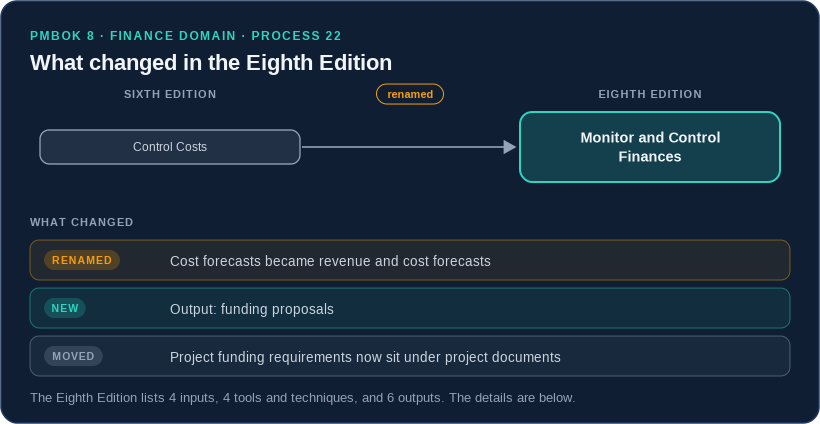
What changed
This is Control Costs under a new name, and the name is wider in two ways. “Monitor and” matches the other monitoring processes in the edition, such as Monitor and Control Project Performance. “Finances” replaces “Costs” in the same way that Plan Financial Management replaced Plan Cost Management.
The outputs show the wider scope
The output list grew from five entries to six, and two of them show the change:
- Revenue and cost forecasts replace the Sixth Edition’s cost forecasts. The process now looks at money coming in as well as money going out.
- Funding proposals are new. When the forecast shows the project will need more money, or money at a different time, this process now produces the proposal for it.
Work performance information, change requests and plan and document updates are still outputs, as before.
The input list went from five entries to four, but nothing was lost. Project funding requirements, which the previous set listed as an input of its own, now sits under project documents.
The tools did not change
The tools are the same four: expert judgment, data analysis, the to-complete performance index, and the project management information system. Earned value analysis, trend analysis and reserve analysis are still listed under data analysis.
If you learned the previous set
Earned value is still at the center of this process, so keep the formulas: cost and schedule variance, CPI and SPI, estimate at completion and TCPI. What is new is the idea that controlling a project’s finances includes its revenue and its funding, not only its spending.
To practise the formulas on your own numbers, use the earned value calculator. It shows every result with the working, including all four EAC formulas and both versions of TCPI.
Inputs, Tools & Techniques, and Outputs
Compared with the Sixth Edition’s Control Costs. Items marked New, Renamed or Moved changed; everything else carries over.
Inputs 4
- Project management plan
- Project documents
- Work performance data
- Organizational process assets
Now under project documents: Project funding requirements
Tools & Techniques 4
- Expert judgment
- Data analysis
- To-complete performance index
- Project management information system
Outputs 6
- Work performance information
- Revenue and cost forecasts RenamedWas cost forecasts
- Change requests
- Funding proposals New
- Project management plan updates
- Project document updates
Every ITTO column in the eighth edition ends in “Etc.”, so the guide presents these lists as typical, not complete. Grouped items such as project documents are shown at the top level. PMBOK® Guide — Eighth Edition, §2.4.2.4. What changed in the ITTOs, across all 40 processes.