Where this came from
This process did not exist under this name before the Eighth Edition. It merges what were previously separate processes:
Develop Schedule is the process that turns the scope into a timeline: identifying the activities, putting them in order, estimating how long each will take, and building the schedule model and its baseline from the result.
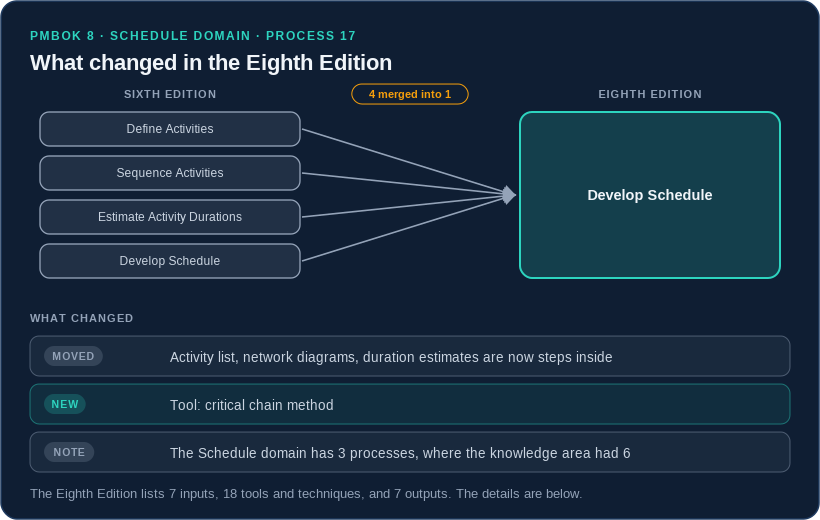
Four processes became one
This is the largest merge in the Eighth Edition. The Sixth Edition split this work across four separate processes:
The Eighth Edition keeps only the last name and folds the other three into it. As a result, the Schedule domain has three processes where the Schedule knowledge area used to have six: Plan Schedule Management, Develop Schedule and Monitor and Control Schedule.
Where the old pieces went
The activity list, the milestone list, the network diagrams and the duration estimates were outputs of their own processes. They are now intermediate products inside one process: they appear among its inputs and in its project document updates, while its main outputs are the same as the old Develop Schedule’s, led by the schedule baseline and the project schedule.
The tools list is now one of the longest in the guide, with 18 entries. Decomposition and rolling wave planning (from Define Activities), the precedence diagramming method and leads and lags (from Sequence Activities), and critical path method and schedule compression (from the old Develop Schedule) all sit in the same column. The four named estimating techniques of the Sixth Edition, analogous, parametric, three-point and bottom-up, are grouped under a single entry, estimation techniques. Critical chain method is listed too, which the Sixth Edition’s Develop Schedule did not list.
Two inputs are worth noticing: the project charter and the development approach. The schedule is built to suit how the project will be delivered, rather than assuming one shape for every project.
If you learned the previous set
The techniques you studied are all still here, and you still need them: a network diagram, a forward and backward pass, float, crashing and fast-tracking. What disappears is the question “which process am I in?” when you are sequencing or estimating. In this edition the answer is always Develop Schedule.
Inputs, Tools & Techniques, and Outputs
Compared with the Sixth Edition’s Define Activities, Sequence Activities, Estimate Activity Durations, and Develop Schedule. Items marked New, Renamed or Moved changed; everything else carries over.
Inputs 7
- Project charter New
- Project management plan
- Development approach New
- Project documents
- Agreements
- Enterprise environmental factors
- Organizational process assets
Tools & Techniques 18
- Expert judgment
- Decomposition
- Rolling wave planning
- Precedence diagramming method
- Logical relationship New
- Leads and lags
- Dependency determination and integration
- Estimation techniques RenamedGroups analogous, parametric, three-point and bottom-up estimating
- Reserve analysis MovedWas listed under data analysis
- Data analysis
- Voting MovedWas listed under decision making
- Schedule network analysis
- Schedule compression
- Critical path method
- Critical chain method New
- Resource optimization
- Project management information system
- Agile release planning
No longer listed here: Meetings
Outputs 7
- Schedule baseline
- Project schedule
- Schedule data
- Project calendars
- Change requests
- Project management plan updates
- Project document updates
Now under project document updates: Activity list; Activity attributes; Milestone list; Project schedule network diagrams; Duration estimates; Basis of estimates
Every ITTO column in the eighth edition ends in “Etc.”, so the guide presents these lists as typical, not complete. Grouped items such as project documents are shown at the top level. PMBOK® Guide — Eighth Edition, §2.3.2.2. What changed in the ITTOs, across all 40 processes.