Where this came from
This process did not exist under this name before the Eighth Edition. Here is what it was called, and where the previous write-up still lives:
Plan Schedule Management is where a project decides how its schedule will be built and run before any dates are set: which scheduling method to use, how precise the estimates need to be, how progress will be measured, and how far the work can drift before someone has to act. The result is the schedule management plan.
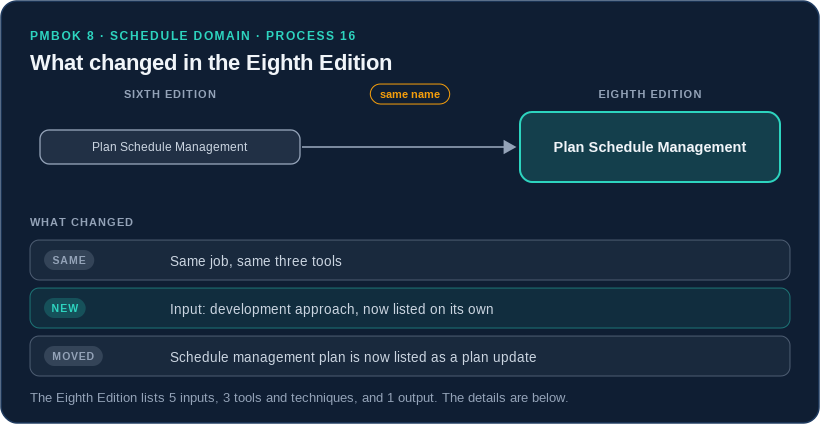
What changed
Less than anywhere else in the Schedule domain. This process kept its name and its job, and the tools are the same three as in the Sixth Edition version: expert judgment, data analysis (alternatives analysis) and meetings. The changes are in how the inputs and the output are listed, and both say something about the edition as a whole.
The development approach is an input of its own
The input list grew from four entries to five. The new entry is the development approach. In the Sixth Edition it reached this process only as one part of the project management plan. It is now listed separately, next to the project charter.
That matters more here than almost anywhere else. Whether a project is predictive, adaptive or hybrid decides what kind of schedule it gets: a critical path model with a baseline, a release and iteration plan, or a mix of the two. Listing the approach on its own makes it the first question the schedule plan has to answer.
The plan is now listed as a plan update
The Sixth Edition listed the schedule management plan as this process’s output. The Eighth Edition lists project management plan updates, with the schedule management plan as the part being updated. The plan itself has not gone anywhere. Monitor and Control Schedule still takes it as an input, and Develop Schedule can update it.
This is a pattern, not a one-off. Plan Scope Management, Plan Stakeholder Engagement, Plan Communications Management, Plan Resource Management and Plan Risk Management list their plans the same way, and the ITTO analysis counts these changes across the edition. The Finance domain is the exception: Plan Financial Management still lists the financial management plan as an output in its own right.
If you learned the previous set
What you know about the schedule management plan still holds: it sets the scheduling method, the level of accuracy, the units of measure, the control thresholds and the rules for measuring performance, such as earned value. What needs updating is the order of thinking. Settle the development approach first, because the rest of the plan follows from it.
Inputs, Tools & Techniques, and Outputs
Compared with the Sixth Edition’s Plan Schedule Management. Items marked New, Renamed or Moved changed; everything else carries over.
Inputs 5
- Project charter
- Project management plan
- Development approach MovedWas part of the project management plan
- Enterprise environmental factors
- Organizational process assets
Tools & Techniques 3
- Expert judgment
- Data analysis
- Meetings
Outputs 1
- Project management plan updates MovedNow carries the schedule management plan
Every ITTO column in the eighth edition ends in “Etc.”, so the guide presents these lists as typical, not complete. Grouped items such as project documents are shown at the top level. PMBOK® Guide — Eighth Edition, §2.3.2.1. What changed in the ITTOs, across all 40 processes.