Before detailed planning, the project manager decides the development approach and the life cycle that suit the product and the environment. This is not a religious choice between waterfall and agile; it is a deliberate match between how well requirements are understood, how often value needs to ship, and the level of risk and regulation involved.
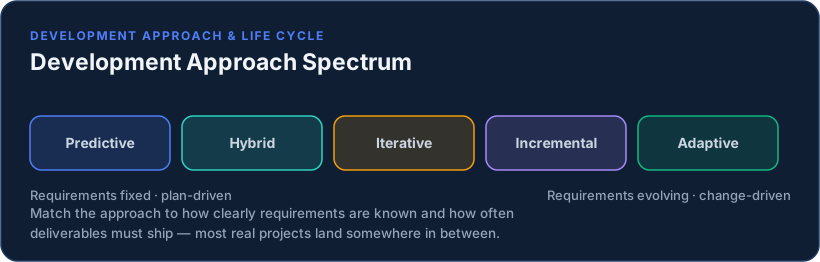
Key decisions in this domain include:
- Development approach — predictive when requirements are stable, adaptive when they will evolve, hybrid when different parts of the work differ.
- Delivery cadence — single delivery, multiple deliveries, or continuous delivery, depending on when stakeholders need value.
- Life cycle and phases — define phases with clear entry and exit criteria so work moves forward only when it is genuinely ready.
- Tailoring — adjust the approach for deliverables individually rather than forcing one method across the whole project.
What these approaches are called in practice
PMI names the ends of the spectrum predictive and adaptive. Most teams use different words for the same things, and the mismatch is a common source of confusion — in interviews, in job posts, and in rooms where half the people say “agile” and mean four different things.
| PMI’s term | What you will hear on a team | What it looks like in the work |
|---|---|---|
| Predictive | Waterfall, plan-driven, traditional | Scope is baselined up front, delivery lands at the end, and change goes through change control. |
| Iterative | Prototyping, design spikes | One deliverable is refined over repeated passes until it is right. |
| Incremental | Phased release, MVP then more | Each pass ships a usable slice and the product grows piece by piece. |
| Adaptive | Agile, Scrum, Kanban, XP | Iterative and incremental together, on a regular cadence, with priorities reset each cycle. |
| Hybrid | Agile delivery inside a fixed contract | Different deliverables run on different approaches within one project. |
Two distinctions are worth holding on to. Agile is not one method — Scrum organizes work into fixed-length sprints with a product backlog and a review-and-retrospective rhythm, while Kanban sets no timebox at all and instead limits how much work is in progress at once. Both are adaptive in PMI’s vocabulary. And iterative and incremental are not synonyms: iterating refines the same thing, incrementing adds new things. Most adaptive approaches do both, which is why the two words are so often blurred.
This vocabulary carries real weight on the exam. PMI’s 2026 Examination Content Outline states that approximately 40% of items represent predictive approaches, with the remaining 60% divided between adaptive/agile and hybrid — and that all three appear across every domain rather than sitting in a section of their own.
Common pitfalls. Picking an approach by fashion or mandate rather than fit; calling a project agile while keeping scope, schedule, and budget fixed; phases with vague exit criteria that let half-finished work slip downstream; and never revisiting the approach as the project and its risks change.
Outcomes to Expect
- Development approaches that are consistent with project deliverables
- A project life cycle consisting of phases that connect the delivery of business and stakeholder value from the beginning to the end of the project
- A project life cycle consisting of phases that facilitate the delivery cadence and development approach required to produce the project deliverables
Checking the Outcomes
- The development approach for deliverables (predictive, hybrid, or adaptive) reflects the product variables and is appropriate given the project and organizational variables.
- Project work from launch to close is represented in the project phases. Phases include appropriate exit criteria.
- The cadence for development, testing, and deploying is represented in the life cycle phases. Projects with multiple deliverables that have different delivery cadences and development methods are represented by overlapping phases or phase repetitions, as necessary.
How It Interacts with the Other Domains
This domain sets the frame for the Planning domain — an adaptive approach plans in rolling waves and backlogs, while a predictive one front-loads detailed baselines. It directly shapes the Team domain (adaptive work needs more self-organization), the Delivery domain (cadence determines when and how often value lands), and the Measurement domain (the chosen life cycle decides whether you track earned value, velocity, or both). Because it influences so much downstream, getting the approach wrong is expensive to unwind later.
Principles Behind This Domain
In the Process View
The processes that do the day-to-day work of this domain:
In the Eighth Edition
Our reading of the Eighth Edition: The Development Approach and Life Cycle domain leaves the performance domains entirely and moves into The Standard, Section 4 (Project Life Cycles), where its topics reappear under almost the same titles: delivery cadence, development approaches, choosing an approach, and project phases.