Planning turns intent into a coordinated path to the outcome. The project manager brings the moving parts into alignment so there are no gaps or contradictions — the schedule fits the budget, the resources exist to do the work, procurements arrive in time, and risks have responses. The amount of planning is itself a judgment call, scaled to the project’s size, uncertainty, and stakes.
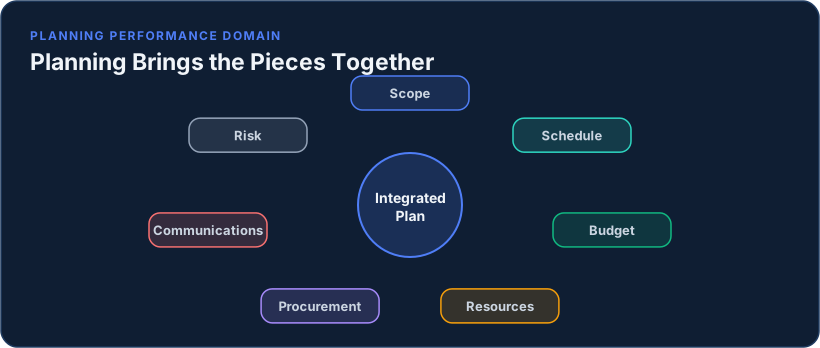
Practical planning work includes:
- Estimate — develop ranges for effort, duration, and cost, and refine them as information firms up.
- Sequence and schedule — order the work, account for dependencies, and build a realistic timeline.
- Right-size the effort — plan near-term work in detail and far-off work at a high level (progressive elaboration and rolling wave).
- Align communications — make sure stakeholders get the information they need to stay aligned.
- Plan for change — set up a backlog or change-control process so plans can adapt to new conditions.
Common pitfalls. Treating the plan as fixed once baselined; planning every detail up front on a project where requirements will change; optimistic estimates with no ranges or reserves; and plans that look complete on paper but do not actually connect — a schedule the budget cannot fund, or scope the resources cannot deliver.
Outcomes to Expect
- The project progresses in an organized, coordinated, and deliberate manner
- There is a holistic approach to delivering the project outcomes
- Evolving information is elaborated to produce the deliverables and outcomes for which the project was undertaken
- Time spent planning is appropriate for the situation
- Planning information is sufficient to manage stakeholder expectations
- There is a process for the adaptation of plans throughout the project based on emerging and changing needs or conditions
Checking the Outcomes
- A performance review of project results against the project baselines and other measurement metrics demonstrates that the project is progressing as planned. Performance variances are within thresholds.
- The delivery schedule, funding, resource availability, procurements, etc., demonstrate that the project is planned in a holistic manner with no gaps or areas of misalignment.
- Initial information about deliverables and requirements compared to current information demonstrates appropriate elaboration. Current information compared to the business case indicates the project will produce the deliverables and outcomes it was undertaken to deliver.
- Project plans and documents demonstrate that the level of planning is appropriate for the project.
- The communications management plan and stakeholder information indicate that the communications are sufficient to manage stakeholder expectations.
- Projects using a backlog show the adaptation of plans throughout the project. Projects using a change control process have change logs and documentation from change control board meetings that demonstrate the change control process is being applied.
How It Interacts with the Other Domains
Planning sits at the center of the performance domains, translating the Development Approach into concrete commitments and feeding the Project Work and Delivery domains the baselines they execute against. It is inseparable from the Uncertainty domain — every estimate and reserve is a response to risk — and from the Measurement domain, which compares actual progress back against the plan. Stakeholder input shapes what gets planned, and the plan in turn manages stakeholder expectations.
Principles Behind This Domain
In the Process View
The processes that do the day-to-day work of this domain:
In the Eighth Edition
Our reading of the Eighth Edition: Planning stops being a domain and becomes a focus area that runs across all seven domains: 19 of the 40 processes are planning processes. Its topics scatter to Resources, Stakeholders and Governance.