Delivery is the point of the whole exercise: meeting requirements and quality expectations to produce deliverables that drive the intended business outcomes. The project manager keeps a clear line of sight from what is being built back to why — the business case and strategy — so the team delivers value, not just outputs. Requirements and quality are managed continuously, because a deliverable that is late, wrong, or unacceptable to stakeholders has not really been delivered.
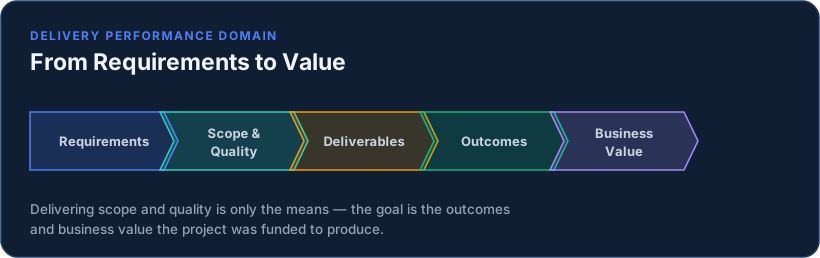
Delivery work centers on:
- Managing requirements — eliciting, prioritizing, and keeping them traceable as understanding evolves.
- Defining and controlling scope — delivering what was agreed and guarding against uncontrolled creep.
- Building in quality — meeting the cost of conformance up front rather than paying the cost of failure later.
- Confirming acceptance — validating deliverables with stakeholders so they accept and are satisfied with them.
- Tracking benefits — keeping the deliverables tied to the outcomes and value in the business case.
Common pitfalls. Optimizing for output volume over outcomes; gold-plating quality beyond what stakeholders need; deferring all testing and acceptance to the end; and losing the thread back to the business case, so the project ships scope that no longer creates value.
Outcomes to Expect
- Projects contribute to business objectives and advancement of strategy
- Projects realize the outcomes they were initiated to deliver
- Project benefits are realized in the time frame in which they were planned
- The project team has a clear understanding of requirements
- Stakeholders accept and are satisfied with project deliverables
Checking the Outcomes
- The business plan and the organization's strategic plan, along with the project authorizing documents, demonstrate that the project deliverables and business objectives are aligned.
- The business case and underlying data indicate the project is still on track to realize the intended outcomes.
- The benefits realization plan, business case, and/or schedule indicate that the financial metrics and scheduled deliveries are being achieved as planned.
- In predictive development, little change in the initial requirements reflects understanding. In projects where requirements are evolving, a clear understanding of requirements may not take place until well into the project.
- Interviews, observation, and end user feedback indicate stakeholder satisfaction with deliverables. Levels of complaints and returns can also be used to indicate satisfaction.
How It Interacts with the Other Domains
Delivery consumes the outputs of the Project Work domain and is bounded by the commitments set in the Planning domain. It depends on the Stakeholder domain to define and accept what good looks like, and on the Measurement domain to show whether benefits are actually being realized. The Development Approach domain determines its cadence — whether value lands in one release or many — and the Uncertainty domain protects it from threats to scope, quality, and schedule.
Principles Behind This Domain
In the Process View
The processes that do the day-to-day work of this domain:
In the Eighth Edition
Our reading of the Eighth Edition: The Delivery domain is split up. Deliverables go to the Scope domain (Develop Scope Structure and Validate Scope), quality is shared between Validate Scope and Manage Quality Assurance, and delivering value moves to Governance and the Focus on Value principle. Nothing called Delivery survives.