Complexity is what makes a project hard to manage because of the number and nature of its interactions — among people, between system parts, and with the environment. This principle treats complexity as something to navigate continuously: stay vigilant for it, and adjust your approach to limit its amount or its impact.
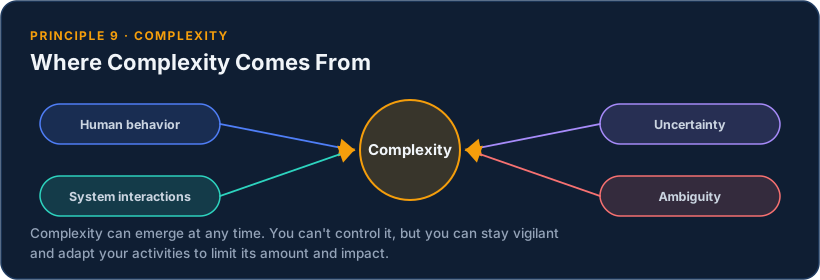
Complexity can emerge at any point and from many sources — human behavior, system interactions, uncertainty, and ambiguity — affecting value, scope, communications, stakeholders, risk, and technology. Because you often cannot foresee it, the response is practical: simplify where you can, decouple tightly linked parts, run small experiments, and watch for the early signs.
Common misunderstanding. Complexity is not the same as complicated or big. A small project can be highly complex if its parts interact unpredictably, while a large one can be straightforward if they do not.
Where This Principle Shows Up
The domains and knowledge areas where this principle does its heaviest lifting:
In the Eighth Edition
In the Eighth Edition, Navigate Complexity is merged with Recognize, Evaluate, and Respond to System Interactions into one principle, Adopt a Holistic View. PMI’s reasoning, paraphrased: A project's organizations, stakeholders and geographies form one complex system, so practitioners have to zoom out to see the related constraints and changes.