Every project runs in an environment it cannot fully predict. This domain is about building awareness of that environment and responding to it on purpose: anticipating threats and opportunities, understanding how many variables interact, and using reserves wisely so surprises do not knock the project off course. It treats uncertainty as something to explore and shape, not just a list of risks to log.
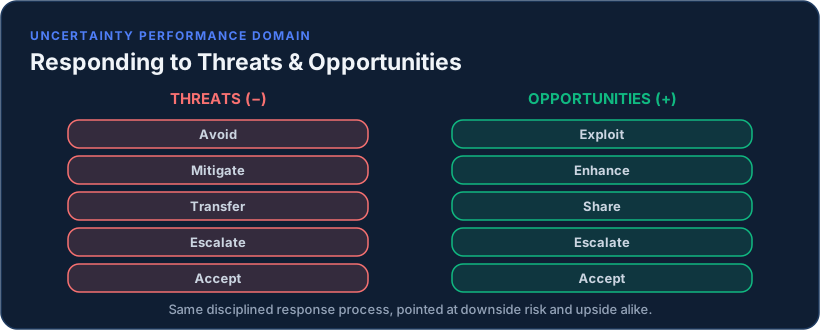
In practice the project manager works across several facets of uncertainty:
- Risk — identify, analyze, and respond to specific threats and opportunities, keeping responses proportional to the constraints.
- Ambiguity — reduce unclear or conflicting information through prototyping, analysis, and incremental decisions.
- Complexity — manage many interacting parts by simplifying, decoupling, and running small experiments.
- Volatility — build in reserves and options to absorb rapid change in cost, schedule, or environment.
- Reserves — use contingency and management reserve deliberately to stay aligned with objectives.
Common pitfalls. Treating risk as a quarterly register update rather than continuous work; focusing only on threats and ignoring opportunities; burning reserves on problems that proactive prevention would have avoided; and responses that cost more than the risk they address.
Outcomes to Expect
- An awareness of the environment in which projects occur, including, but not limited to, the technical, social, political, market, and economic environments
- Proactively exploring and responding to uncertainty
- An awareness of the interdependence of multiple variables on the project
- The capacity to anticipate threats and opportunities and understand the consequences of issues
- Project delivery with little or no negative impact from unforeseen events or conditions
- Opportunities are realized to improve project performance and outcomes
- Cost and schedule reserves are utilized effectively to maintain alignment with project objectives
Checking the Outcomes
- The team incorporates environmental considerations when evaluating uncertainty, risks, and responses.
- Risk responses are aligned with the prioritization of project constraints, such as budget, schedule, and performance.
- Actions to address complexity, ambiguity, and volatility are appropriate for the project.
- Systems for identifying, capturing, and responding to risk are appropriately robust.
- Scheduled delivery dates are met, and the budget performance is within the variance threshold.
- Teams use established mechanisms to identify and leverage opportunities.
- Teams take steps to proactively prevent threats, thereby limiting use of cost or schedule reserve.
How It Interacts with the Other Domains
Uncertainty is woven through every domain: it shapes the Planning domain's estimates and reserves, informs the Development Approach (more uncertainty favors adaptive, learn-as-you-go approaches), and protects the Delivery domain's scope, quality, and dates. It relies on the Team and Stakeholder domains to surface risks early — a safe team and engaged stakeholders are the best early-warning system — and feeds the Measurement domain, which turns leading indicators into timely risk responses.
Principles Behind This Domain
In the Process View
The processes that do the day-to-day work of this domain:
In the Eighth Edition
Our reading of the Eighth Edition: The Uncertainty domain is narrowed and renamed as the Risk domain. Ambiguity and general uncertainty stay; complexity moves to the Adopt a Holistic View principle, and volatility loses its own treatment. The broad idea of uncertainty contracts back to conventional risk management.