Projects are delivered by people and for people, so the project manager treats stakeholder engagement as ongoing work rather than a one-time register. The job is to know who holds a stake, understand what they need and fear, and decide how to keep each relationship productive as influence and interest shift from phase to phase.
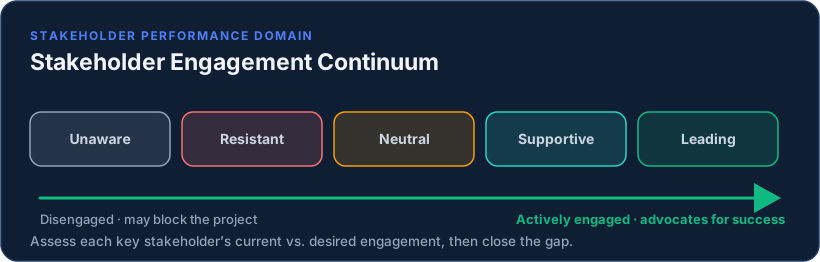
In daily practice this is a repeating loop rather than a phase:
- Identify — sponsors, customers, end users, regulatory and governing bodies, suppliers, PMOs, steering committees, and the project team itself; revisit the list every phase.
- Understand and analyze — capture each stakeholder’s interests, influence, expectations, and likely attitude using tools such as a power/interest grid or salience model.
- Prioritize — concentrate effort on the few who can make or break the project instead of spreading attention evenly.
- Engage — tailor the level and style of communication and involvement to move people along the continuum above.
- Monitor — watch for shifts in behavior and sentiment, and in the issue and risk registers, then adjust the approach.
Common pitfalls. Treating engagement as status reporting instead of two-way dialogue; mapping stakeholders once at kickoff and never updating it; over-investing in friendly, low-power stakeholders while neglecting the quiet high-power ones; and mistaking activity — a stream of emails — for genuine alignment. Strong project managers engage early, listen for the real concern behind an objection, and resolve resistance before it hardens into a blocker.
Outcomes to Expect
- A productive working relationship with stakeholders throughout the project
- Stakeholder agreement with project objectives
- Stakeholders who are project beneficiaries are supportive and satisfied while stakeholders who may oppose the project or its deliverables do not negatively impact project outcomes
Checking the Outcomes
- Productive working relationships with stakeholders can be observed; the movement of stakeholders along a continuum of engagement can indicate the relative level of satisfaction with the project
- A significant number of changes or modifications to the project and product requirements in addition to the scope may indicate stakeholders are not engaged or aligned with the project objectives
- Stakeholder behavior, along with surveys, interviews, and focus groups, indicates whether beneficiaries are satisfied and supportive or whether they oppose the project and its deliverables
- A review of the project issue register and risk register can identify challenges associated with individual stakeholders
How It Interacts with the Other Domains
The Stakeholder domain is tightly coupled with the Team domain, because the project team are themselves stakeholders and the same skills of listening, negotiating, and building trust apply inside and outside the team. It feeds the Planning domain by shaping scope, requirements, and the communications approach around stakeholder needs, and it both informs and draws on the Uncertainty domain, since overlooked or misaligned stakeholders are a leading source of risk while engaged stakeholders help spot and respond to threats early. Delivery and Measurement depend on it as well: stakeholders define what counts as value and ultimately judge whether the delivered outcomes meet expectations.
Principles Behind This Domain
In the Process View
The processes that do the day-to-day work of this domain:
In the Eighth Edition
Our reading of the Eighth Edition: Stakeholder is the only Seventh Edition domain that survives almost unchanged, now called the Stakeholders performance domain. It also takes in the three communications processes, so it holds seven processes, all with their old names.